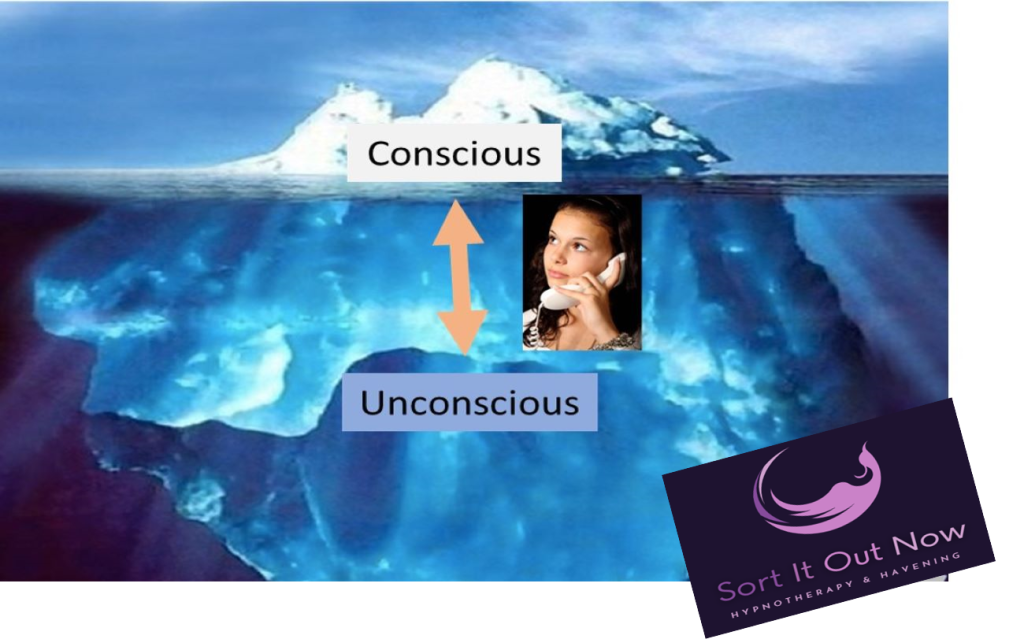
The subconscious part of the mind controls bodily functions which many of us take for granted, such as digestion of our food, hormone production, balance, temperature control etc. Luckily we do not have to expend any conscious mental effort to deal with all of these things!
This leaves our conscious mind “free” to deal with current issues, such as our daily routine…or does it?!
We would all like to believe that we are using our free will to make conscious decisions in our lives, but studies such as this (Soon CS, Brass M, Heinze HJ, Haynes JD. Unconscious determinants of free decisions in the human brain. Nat Neurosci. 2008 May;11(5):543-5. doi: 10.1038/nn.2112. Epub 2008 Apr 13. PMID: 18408715.) show that the subconscious actually makes decisions up to 10 seconds before you are consciously aware that you have decided!
Now, just take a moment to consider this – how many of our decisions are really “conscious”?
Of course, it’s usually vital that the subconscious intervenes in this way – for example, when driving do you need or want to think consciously about every movement? That would be exhausting – the subconscious takes a repeated behaviour, such as driving, and conveniently turns it into a learned habit – fantastic!
What may not be so fantastic is when you realise that you have a learned behaviour which you do NOT want any longer – such as smoking – or when the subconscious mind “learned” that speaking in public was a potential survival threat due to forgetting your lines during the school play aged 6!
We can unwittingly end up with all sorts of unwanted avoidance behaviours, “flight, fight or freeze” responses and destructive habits thanks to the amazing ability of the subconscious mind to learn FAST!
The great news is that there is nothing “wrong” or that needs “fixing”. The subconscious part of the brain is continually doing its best job to keep us “safe”.
That is – safe from whatever it has previously perceived as a “threat” (such as everyone staring at us as we frantically try to remember the lines)….or “safe” from uncomfortable emotions through distractions such as “comfort eating” or scrolling on social media which provide dopamine “hits”.
This means that events which happened in the past and made us uncomfortable, frightened, angry, feel threatened, humiliated, ashamed or embarrassed could potentially* be causing the subconscious to make current decisions “for us” in our “best interests”, while we remain oblivious or even come to think that this is “just the way we are”.
And so we carry out our habits, behaviours, likes and dislikes, sometimes falling into repeated cycles or patterns in an automatic, unconscious way, without realising that we do indeed have a choice and that we can choose a different way.
When we examine the idea of “this is just the way I am,” is it really true?
Were we born with the need to avoid public speaking? Or “creepy crawlies”? Or did we pick these up “along the way”…? Why do some people absolutely love speaking in public or tarantula-keeping? Is that genetics…? Or down to something else? Nature or nurture? If it’s nurture, can we not nurture ourselves back to the way we were before we “learned” to be afraid…?
*the potential for past distressing events to cause changes in our responses, behaviours etc. is highly individual and determined by many factors – something which is “like water off a duck’s back” to one person, can cause a devastating impact on another.
How can we uncover and change these sorts of unconscious behaviours? There are so many ways, such as…
- Identify the behaviour / pattern / habit / thoughts that you are not willing to put up with any longer and bring these more and more into the conscious by recognising any times they are kicking in e.g. what are the triggers?
- Challenge the behaviours / thoughts – are they relevant today? Do they make sense now that you are an adult, with agency in your life? If you are having an argument with yourself then can you identify 2 separate “parts” of your mind?
- Take back the power that the “part” of the mind that is generating the behaviour had over you (“go on – it’s the weekend…”!) by giving it a name and a character – as silly as you like! Are you going to take orders from Bugs Bunny??
- Find out why this behaviour was created in the first place – what was the causative event? Looking at it now from a different perspective – perhaps as an adult, rather than a child – does have the same impact or significance? Spend some time “processing” the event until it no longer bothers you in the same way
The above list is just a tiny snapshot of how you might begin to combat unwanted behaviours and may take a long time to master. We an speed up this process by connecting with the subconscious mind, communicating directly with it, aiding the processing of previously unprocessed, distressing past events and reframing “learnings” into positive resources which generate new options and broaden our responses to include these we desire from our conscious free will.
We can reclaim our Selves and operate authentically from the person we truly are, despite past events.
Connecting with the Subconscious through “Hypno-sis”
Hypnotherapists use the state of hypnosis help clients gain access to the subconscious.
Hypnosis is a natural state which everyone experiences every day to a greater or lesser extent – however, we tend to call it “daydreaming” or “autopilot” or even “away with the fairies”, rather than hypnosis!
Next time you become really engrossed in a good book or TV show, notice how all of your attention is focused on something outside of your own reality. Notice how time can become distorted – either going by in a flash or slowing down – and how you didn’t even notice that the telephone was ringing. It’s easy to drift off in meetings, during lectures, or even whilst driving, leaving you to wonder how you arrived at your destination without fully remembering the journey.
During the hypnotic state, the brain passes into the “alpha” state, a pleasant “resting” state in which creativity and imagination can flourish; indeed until the age of 8 children spend most of their waking hours in the alpha state! The brain also passes through the alpha state on the way into, and out of, sleep.
Many people ask the question: “Can I become hypnotised?” – well, if you ever daydream, watch TV or sleep then the answer is a resounding YES!
About Hypno-therapy
Imagine putting the natural alpha state to good use? During hypnosis, the subconscous mind is more open to suggestions and can absorb information like a sponge – hence it is easier to recall the lyrics of the music you were listening to whilst you were struggling to consciously revise for an exam. Positive suggestions for the changes that you want to make in your life are therefore easier to install, subtly changing the “programs” running in the background.
The heightened suggestibility of the subconscious during hypnotic states is a well-known phenomenon, but did you know that in this state it is also possible to have direct communication with the subconscious mind in order to gain insight and make changes which are truly long-lasting? To eradicate the root cause of a symptom and ensure it won’t simply pop back as something new?
Hypnotherapy uses light to very deep states of hypnosis to address unwanted problems. It can be adapted to deal with almost any problem as it is a tool which is as flexible and versatile as the imagination.
During a hypnotherapy session a collaborative approach is taken to combat unwanted behaviours, thoughts, habits etc – we listen to the subconscious mind and find out what is at the root of the problem. We help this part of the mind to effectively process and reframe any past events which have caused the issue.
What Is Havening?
Havening technique is a psychosomatic therapy which uses current unwanted feelings in the body – such as butterflies in the tummy when thinking about public speaking – as a “bridge” to whatever past events are at the root cause.
Havening uses repetitive sensory stimuli to disrupt “trauma memory networks” which were formed in the amygdala part of the brain. The amygdala stores these trauma memory networks as a result of past distressing events and is always on the “lookout” for any potential dangers or “threats”. If one of the senses detects a “stimulus” which is similar to a sight / smell / sound etc present during the past distressing event then the amygdala can take over and cause a “fight, flight or freeze” response to kick in. During these times, the rational mind is taken “offline” somewhat and it is extremely difficult to “intervene” in a conscious way.
Repetitive sensory stimuli are already used widely by the NHS – for example, EMDR uses eye movements or repetitive sounds for auditory bilateral stimulation to disrupt trauma memory networks. When repetitive sensory stimuli are introduced, the brain produces very slow waves, called delta waves. Delta waves are typically only produced during sleep.
Havening is a relatively new therapy which uses touch* – specifically light strokes down the upper arms – to achieve the same effect. The brain begins to produce delta waves, but crucially, the body also produces positive chemicals, such as oxytocin and serotonin. This thought to be due to the presence of “affective” touch* – a caregivers touch, such as received as a baby from a carer. The body and subconscious recognise this touch as “safe” and thus allows a “biological safety” to be established, whilst accessing potentially distressing memories.
*French, J., Sarkar, M., Hunter, K., Sumich, A., Heym, N., Hatch, L., & Burgess, T. (2022). The Power of Touch: The Effects of Havening Touch on Subjective Distress, Mood, Brain Function, and Psychological Health. Psychology & Neuroscience, 15(4), 332–346. https://doi.org/10.1037/pne0000288
During havening, distressing memories may be accessed for less than a second before the conscious mind is taken away using a series of “distractions”, such as counting, the alphabet game, visualisations etc. Whilst havening continues, the distressing event can begin to be processed effectively, in a way which could not take place at the time of its happening. It is theorised that “AMPA” receptors bound to the amygdala as part of the trauma memory network can be removed, thus lessening “symptoms” caused by their presence, such as intrusive memories (flashbacks), sleep issues, anxiety etc.
*McGlone F, Uvnäs Moberg K, Norholt H, Eggart M, Müller-Oerlinghausen B. Touch medicine: bridging the gap between recent insights from touch research and clinical medicine and its special significance for the treatment of affective disorders. Front Psychiatry. 2024 May 22;15:1390673. doi: 10.3389/fpsyt.2024.1390673. PMID: 38881553; PMCID: PMC11177324.
Using Hypnotherapy and Havening Together
In most sessions a combination of Havening and Hypnotherapy are used.
Havening is excellent dealing with past events which may be at the root cause of a current issue. It can:
- quickly creating biological safety which enables the subconscious to reveal associations of current symptoms to past events
- enable the content of past events to remain completely private, if that is the client’s wish – the practitioner need only know that a memory is being worked upon
- quickly desensitise current “triggers”
It is important help the subconscious mind to reframe and process underlying past events when trying to “remove” an unwanted symptom. Remember that the subconscious mind never “wastes energy” unnecessarily – it will have a reason for doing whatever “job” it is carrying out – even if the long-term consequences of that job seem destructive.
Hypnotherapy is used during sessions to continue to address a current issue using various techniques, from the creation of a positive anchor, “negotiating” with parts, direct or indirect suggestions and metaphors etc.
What do clients say after a session?
Following a session, most clients report that they feel calmer and lighter, as though a weight has been lifted. Despite accessing potentially upsetting past events, clients are able to move their conscious mind away very rapidly and are often laughing again within seconds. Past intrusive memories, that have been worked on, no longer hold an emotional “sting” and are difficult to access, even though they were difficult to NOT think of before the session.
Clients leave feeling more optimistic and positive with tools, such as self-havening, to help them deal with negative emotions in a safe way at home or out-and about.
Want to get the most out of a session?
There is only one thing you need to bring with you – the desire for a positive change in your life.